
When people start building tools around Chaturbate, they usually run into the same confusion pretty quickly: “Why are there multiple APIs and why does none of it feel consistent?”
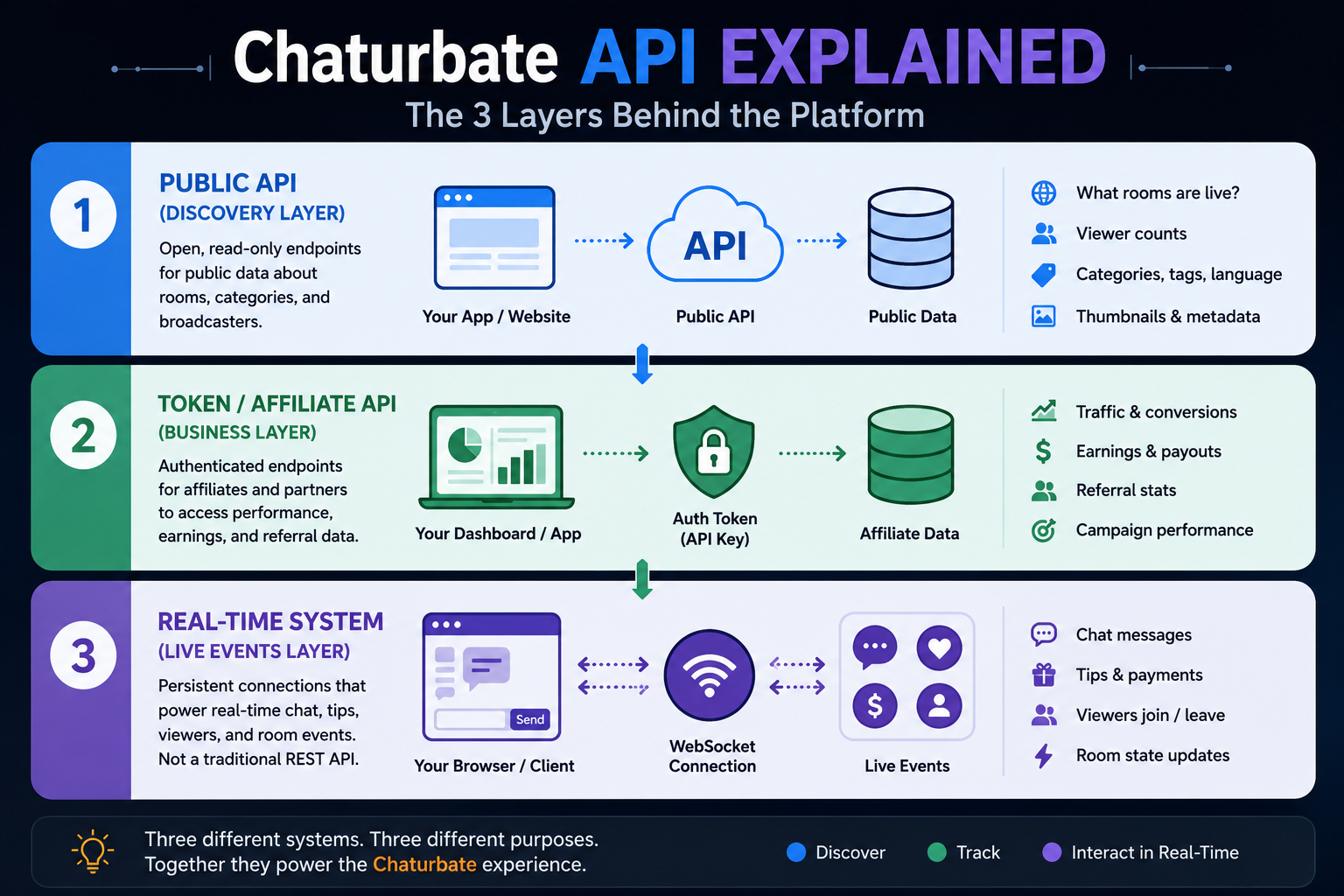
The short answer is that it’s not really one unified API system. It’s more like three different layers that evolved over time, each serving a different purpose.
Let’s break it down in a way that actually makes sense.
1. Public API — the “what’s happening right now” layer
This is the easiest one to understand.
The public API is basically just structured access to what you already see on the website:
- who is live
- viewer counts
- room metadata
- tags, categories, language
- preview thumbnails
No authentication, no tokens. You just request the data and get JSON back.
Think of it less like a “developer platform” and more like:
“a machine-readable version of the homepage”
It’s heavily read-only and rate-limited, because it’s designed for discovery use cases (directories, listings, analytics dashboards, etc.).
2. Token / Affiliate API — the “business layer”
The second layer is where things get a bit more controlled.
This is where you start seeing:
- affiliate tracking
- campaign performance
- referral stats
- earnings and conversion data
Access here requires some form of token or authentication key. This is not meant for general public browsing — it’s for partners and affiliates who are driving traffic into the platform.
Architecturally, you can think of it as:
“the accounting and attribution system sitting behind the scenes”
It’s still HTTP-based and fairly traditional, but the data is scoped to what your account is allowed to see.
3. The confusing one — Internal Real-Time System (Chat, Tips, Live Events)
This is the part that usually throws people off completely.
Unlike the first two, this is not a clean, documented REST API.
Instead, it’s a mix of:
- WebSocket-style connections (real-time bidirectional streams)
- session cookies (your logged-in browser identity)
- room-specific tokens (temporary access keys for joining a live session)
- internal event channels (chat messages, tips, viewers joining/leaving, stream state changes)
So what does that actually mean in plain English?
When you open a broadcaster’s room, your browser doesn’t just “poll an API”.
Instead:
- It opens a persistent connection to the server
- The server continuously pushes updates to you
- Your session proves who you are and what room you’re in
- Events flow in real time (chat, tips, joins, etc.)
So instead of:
“Ask → get response → close connection”
It becomes:
“Connect once → keep listening → react to live events”
Why this exists (and why it’s messy)
This system exists because real-time chat and tipping cannot rely on simple HTTP requests. You’d get latency, race conditions, and constant overhead.
So the platform evolved a more “live system” architecture:
- event-driven messaging
- persistent connections
- browser-session coupling
The downside is that:
- it’s not officially documented
- endpoints can change
- behavior depends heavily on frontend logic
So developers often describe it as:
“half API, half browser internals, half reverse engineering”
(yes, that’s three halves — that’s intentional irony)
Putting it all together
If you zoom out, the structure looks like this:
- Public API → discovery and browsing data
- Token API → affiliate/business tracking
- Internal real-time system → everything happening inside a live room
Or even simpler:
- “What rooms exist?”
- “What traffic did I send?”
- “What is happening right now, second by second?”
Final thought
The biggest mistake people make is assuming there’s one clean API design hiding somewhere. There isn’t.
It’s a platform that grew organically, with different systems layered on top of each other as needs evolved — especially around real-time interaction.
Once you understand that, everything else starts to feel less confusing and more like:
“Oh… this is just a web app showing its internal plumbing.”