Part 2 of the Live Data Publishing Framework (LDP Framework) Series
In the first article, I introduced the Live Data Publishing Framework (LDP Framework) and explained the philosophy behind building modular, data-driven publishing platforms.
The next logical question is:
Where does the live data actually come from?
The answer is the Data Engine.
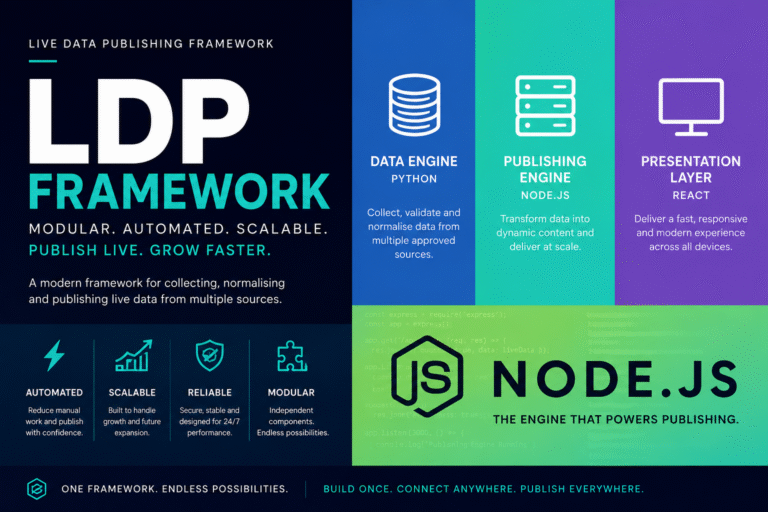
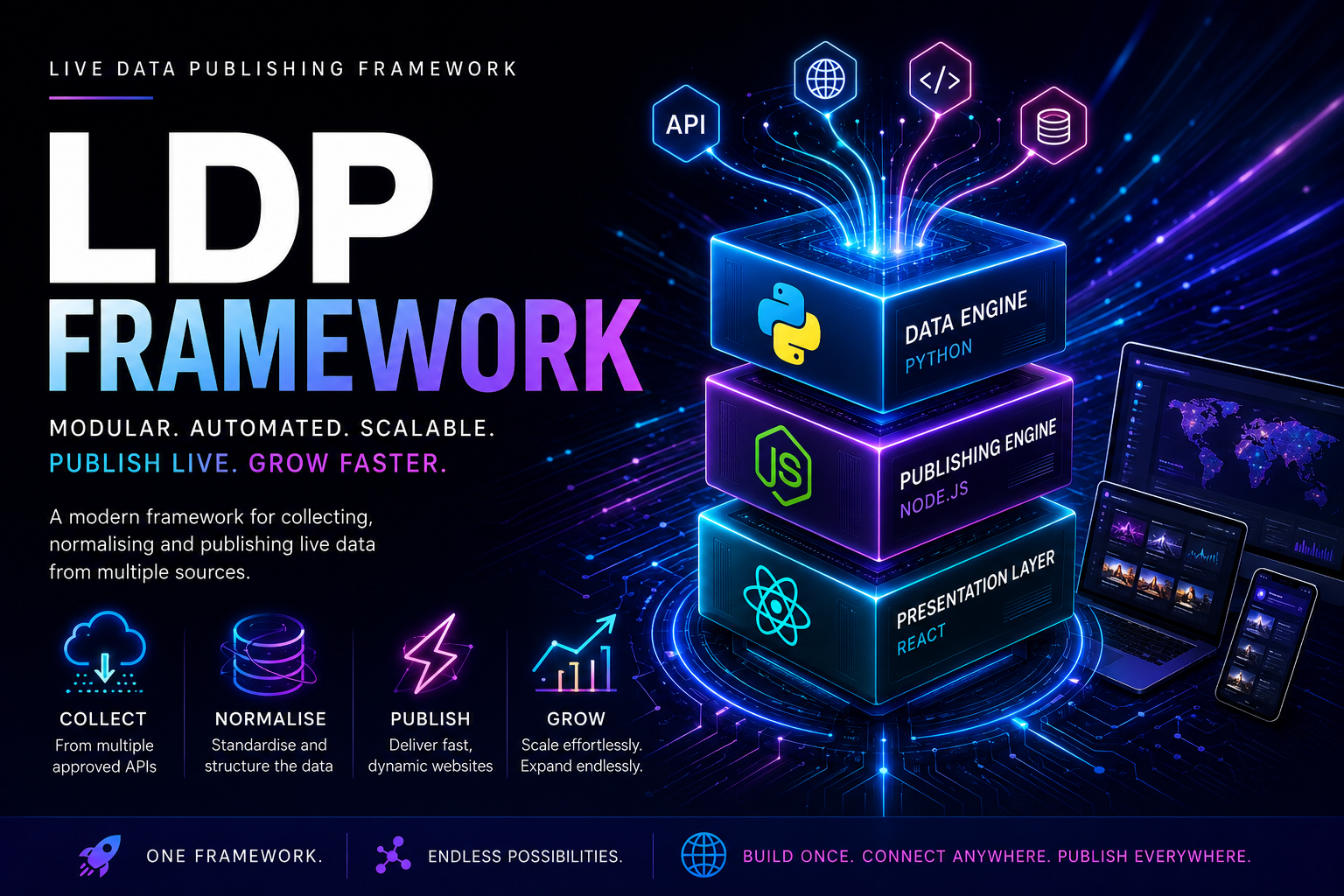
Rather than allowing the website to communicate directly with multiple external services, the LDP Framework uses a dedicated data collection layer written in Python.
This design keeps the system modular, scalable and significantly easier to maintain.
Why Separate Data Collection?
Many websites retrieve information directly from external APIs every time a visitor loads a page.
While this can work for smaller projects, it quickly introduces unnecessary complexity.
Each external service has its own API structure, authentication methods, update frequency and response format.
If every page on the website communicates directly with every external API, the application becomes tightly coupled to those services.
A change made by one provider can affect the entire website.
The LDP Framework avoids this problem by introducing a dedicated Data Engine.
Its responsibility is simple:
Collect. Validate. Standardise. Store.
Nothing more.
Why Python?
Python has become one of the world’s most widely used programming languages for automation and data processing.
It offers mature libraries for:
- HTTP requests
- JSON processing
- Scheduled tasks
- Error handling
- Data transformation
- Logging
- Database integration
For this reason, Python is an excellent choice for collecting structured information from approved APIs and converting it into a consistent internal format.
The Data Engine is not responsible for displaying information.
It simply prepares reliable data for the rest of the framework.
Thinking in Connectors
One of the design principles behind the LDP Framework is that every data source should be independent.
Instead of creating one large program that attempts to communicate with every platform, each supported source is treated as its own connector.
For example:
- Connector A retrieves data from Platform A.
- Connector B retrieves data from Platform B.
- Connector C retrieves data from Platform C.
Each connector understands only one external system.
The rest of the framework never needs to know how that connector works internally.
This approach keeps development manageable and makes future expansion considerably easier.
Normalising the Data
No two APIs are exactly alike.
One platform may call a field “username”.
Another may call it “performer”.
A third may use “display_name”.
The Data Engine converts these different structures into one consistent internal format.
Once the information has been normalised, the Publishing Engine no longer needs to know where the data originally came from.
It simply works with a standard set of fields.
This separation is one of the most important architectural decisions within the framework.
Why This Matters
By separating data collection from website presentation, the framework gains several advantages.
- External services remain isolated from the frontend.
- New connectors can be added without redesigning the website.
- Individual connectors can be maintained independently.
- Errors become easier to identify.
- Performance can be improved through intelligent scheduling and caching.
- The framework remains adaptable as external services evolve.
Rather than building one large application, the system becomes a collection of smaller, well-defined components working together.
Looking Ahead
The Data Engine is the foundation of the Live Data Publishing Framework.
Without reliable, structured data, there is nothing meaningful to publish.
In the next article, I will explore the Publishing Engine itself and explain why Node.js provides the flexibility and performance needed to transform structured data into a modern publishing platform.
LDP Framework Status
Framework: Live Data Publishing Framework (LDP Framework)
Current Module: Data Engine
Primary Technology: Python
Development Phase: Architecture and Technical Specification
Next Article: The Publishing Engine – Why Node.js Sits at the Centre of the Framework