If you’ve ever looked into building tools around Stripchat, you’ve probably discovered that the term “Stripchat API” isn’t as straightforward as it first appears.
Many developers expect to find one comprehensive API that does everything. In reality, Stripchat uses several different communication methods depending on what you’re trying to achieve. Once you understand how these layers fit together, the platform becomes much easier to work with.
This guide explains the three main layers in plain English, without assuming you’re already an experienced developer.
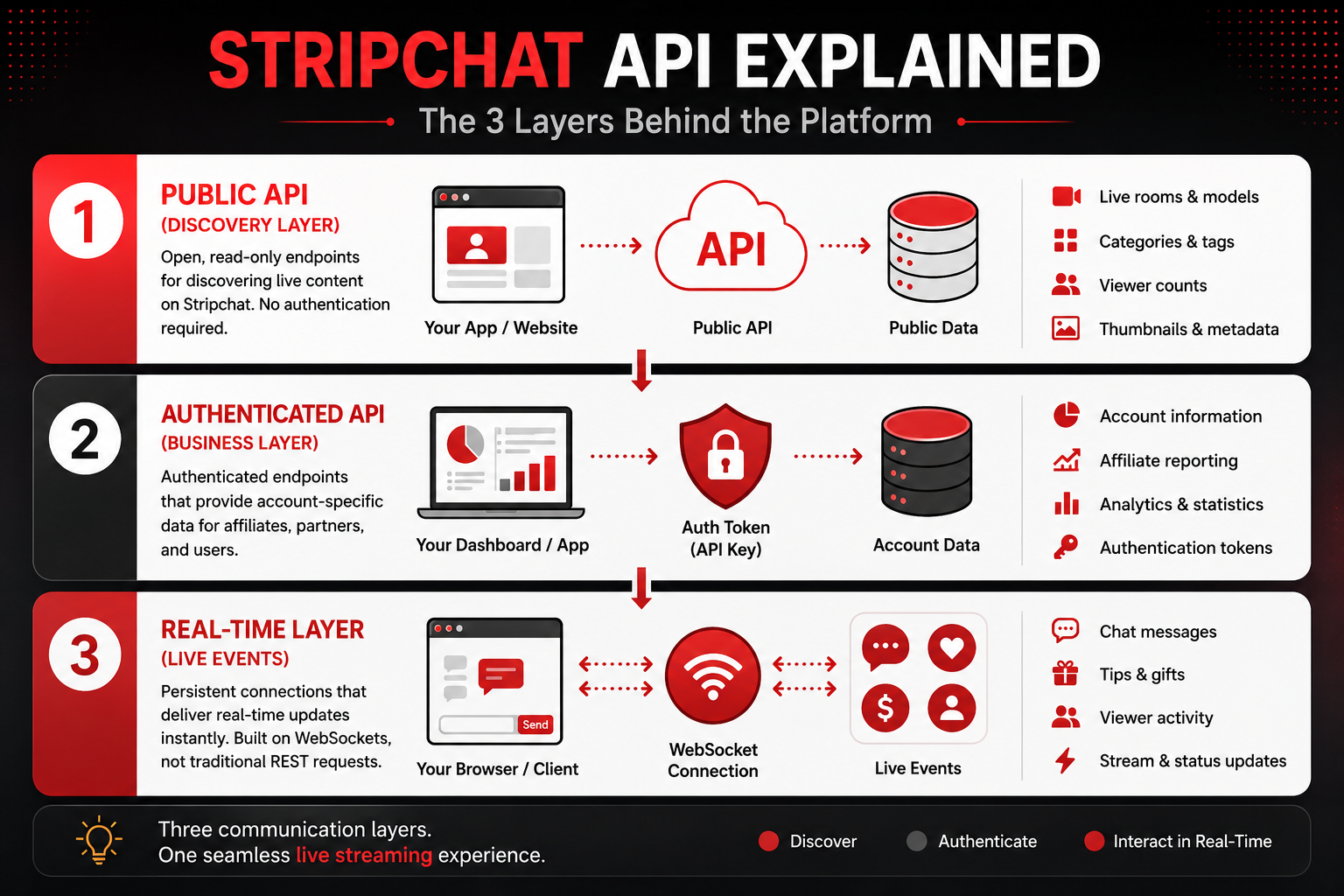
1. Public API – Discovering Live Content
The Public API is the easiest place to start.
It provides access to information that’s already publicly available on the platform, making it useful for applications that display or analyse live broadcasts.
Typical data includes:
- Live rooms
- Viewer counts
- Categories and tags
- Languages
- Preview images
- Basic broadcaster information
No authentication is usually required for this type of data because it’s intended for discovery rather than account management.
Think of it as asking the platform:
“Show me what’s currently happening.”
The server responds with structured data that your application can easily understand and display.
2. Authenticated API – Accessing Account Features
The second layer requires authentication.
Instead of asking for public information, your application proves its identity using an authentication token or API credentials before requesting data.
This allows access to features such as:
- Account-specific information
- Affiliate reporting
- Performance statistics
- Analytics
- Private resources
A simple way to think about this is comparing two websites.
Without logging in, you can browse products in an online store.
After logging in, you can suddenly see your orders, saved addresses and purchase history.
The website hasn’t changed—you’ve simply been granted permission to access information that belongs to your account.
That’s exactly what authentication does for an API.
3. Real-Time Communication – The Live Experience
This is the part that often confuses people because it works differently from a traditional API.
Most APIs work like this:
- Your application asks for information.
- The server replies.
- The connection ends.
Live streaming doesn’t work very well this way.
Imagine having to ask the server every second:
“Any new chat messages?”
“Any new tips?”
“Has another viewer joined?”
That would create unnecessary traffic and delays.
Instead, Stripchat uses persistent real-time connections.
Once connected, the application stays connected.
Whenever something happens, the server immediately sends the update to your browser.
These live events can include:
- Chat messages
- Tips and gifts
- Viewer activity
- Stream status changes
- Room updates
Many modern live streaming platforms achieve this using technologies such as WebSockets, which allow information to flow instantly in both directions without repeatedly creating new connections.
A good analogy is this:
A traditional REST API is like sending an email—you ask a question and wait for a reply.
A real-time connection is like being on a phone call. Once you’re connected, information flows naturally without needing to reconnect every few seconds.
Putting It All Together
The easiest way to understand the Stripchat platform is to think of it as three different communication layers working together.
| Layer | Purpose | Typical Use |
|---|---|---|
| Public API | Public information | Live rooms, categories, metadata |
| Authenticated API | Account-specific access | Analytics, affiliates, private resources |
| Real-Time Layer | Instant communication | Chat, tips, viewer activity, stream updates |
Each layer solves a different problem, but together they create the smooth experience users expect from a modern live streaming platform.
Final Thoughts
The biggest misconception about the Stripchat API is that it’s a single system.
In reality, it’s a collection of technologies designed for different jobs.
The Public API makes discovery simple.
Authentication protects account-specific information.
Chaturbate vs Stripchat: What’s the Difference?
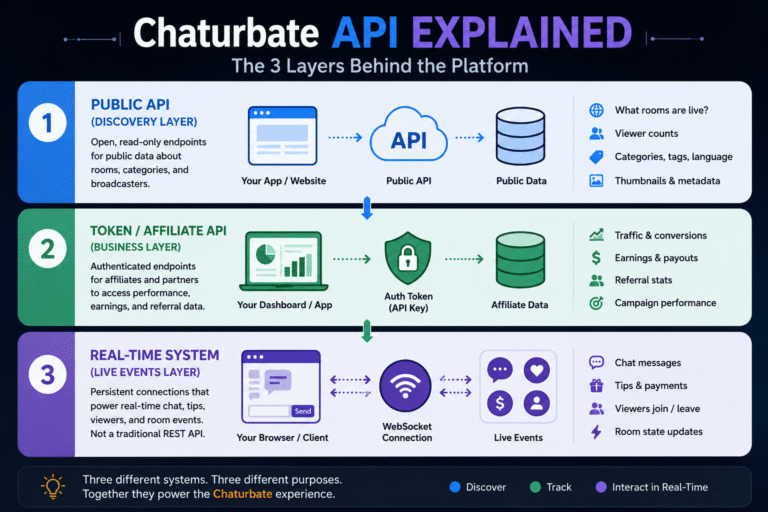
If you’ve read our guide to the Chaturbate API, you might be wondering whether Stripchat works in the same way.
The short answer is yes and no.
Both platforms rely on the same fundamental building blocks. They provide public data for discovering live rooms, authenticated access for account-specific features, and real-time communication to power chat, tips, and live events.
The biggest difference lies in how those systems are presented.
With Chaturbate, developers often find themselves working with a platform that has evolved over many years. Some functionality is publicly documented, while other parts are closely tied to the website itself or rely on browser sessions and internal communication. As a result, it can sometimes feel like you’re piecing together several different systems.
Stripchat, on the other hand, feels more like a modern web application. The distinction between public information, authenticated services, and real-time communication is easier to understand because each layer has a clearer purpose within the overall platform architecture.
That doesn’t necessarily mean one platform is “better” than the other. Both have grown to support millions of live interactions every day, and both use technologies that are common across modern streaming platforms.
From a developer’s perspective, it’s helpful to think of them like two different cities. They both have roads, traffic lights and public transport, but the layout is different. Once you understand the map, getting around becomes much easier.
If you’re just beginning to explore live streaming APIs, Stripchat is often the easier platform to understand conceptually. Once you’re comfortable with ideas such as authenticated requests and real-time event streams, the architecture behind Chaturbate becomes much less intimidating.
Ultimately, both platforms demonstrate an important lesson in modern software development: there isn’t a single “API” doing all the work. Instead, multiple technologies work together behind the scenes to create the seamless live streaming experience that users see on the front end.
Real-time communication keeps live broadcasts responsive and interactive.
Once you understand these three layers, the overall architecture becomes much easier to understand, whether you’re building an affiliate tool, analytics dashboard or simply learning how modern streaming platforms communicate behind the scenes.