A Modular System for Building Automated, Data-Driven Websites
The internet is increasingly powered by live data.
Whether it’s job listings, property feeds, product catalogues, sports results, or streaming platforms, modern websites are no longer static pages—they are constantly updated systems built on structured data.
The Live Data Publishing Framework (LDP Framework) is a modular approach to building websites that are driven by live, structured data sources.
Rather than being a single website or a fixed template, it is a reusable system designed to:
Collect structured data from approved sources
Organise and normalise that data
Publish it dynamically through a modern web interface
Why This Framework Exists
Most websites that rely on live or frequently updated data run into the same problems:
- Data is inconsistent across sources
- Manual updates do not scale
- Frontend and backend logic become tightly coupled
- Adding new data sources requires significant redevelopment
- Systems are difficult to maintain or extend over time
The LDP Framework is designed to address these issues by separating the system into clearly defined layers.
The Core Architecture
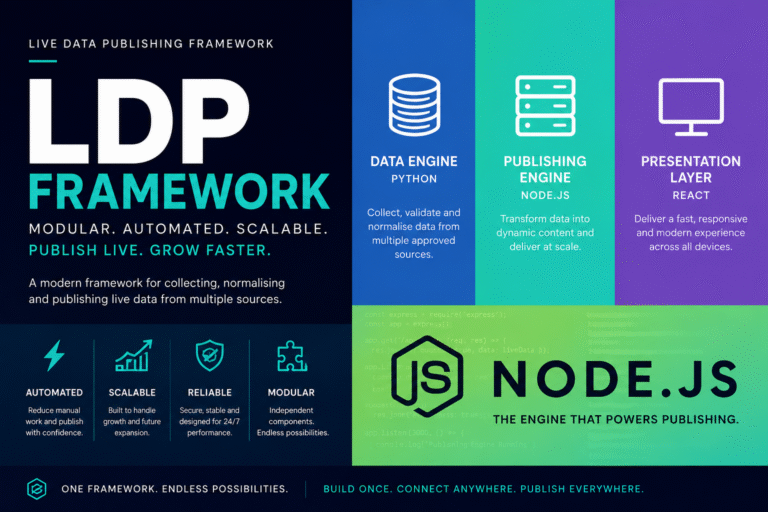
The framework is built around three independent modules:
1. Data Engine (Python Layer)
The Data Engine is responsible for connecting to approved APIs and data feeds.
Its job is to:
- Fetch structured data from external sources
- Validate and clean incoming data
- Convert data into a consistent internal format
- Store processed data for use by the system
Python is used for this layer due to its strength in data handling, API integration, and automation.
This layer does not deal with the website itself. It focuses purely on data acquisition and processing.
2. Publishing Engine (Node.js Layer)
The Publishing Engine is the core application layer.
It handles:
- Website routing and structure
- Search and filtering
- Category and page generation
- User-facing dashboards
- API communication with the data layer
- System logic and automation workflows
Node.js is used here to provide a fast, scalable backend capable of handling real-time updates and web requests efficiently.
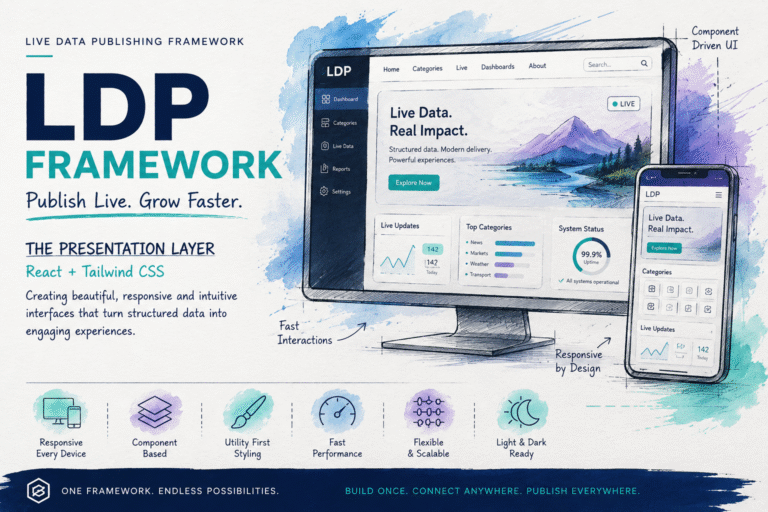
3. Presentation Layer (Frontend)
The frontend is responsible for how users interact with the system.
It is built using modern frontend technologies such as:
- React (UI components and state management)
- Tailwind CSS (styling and layout)
- Grid-based or dashboard layouts (for dynamic content display)
This layer takes structured data from the Publishing Engine and presents it in a clear, usable format.
Why This Separation Matters
Separating the system into three modules provides several key advantages:
- Each layer can be developed and tested independently
- New data sources can be added without changing the frontend
- The system becomes easier to scale and maintain
- Different developers can work on different parts of the system
- The architecture remains flexible over time
In short, the goal is to avoid building a tightly coupled system that becomes difficult to evolve.
First Implementation
The initial version of the LDP Framework will focus on a single real-world use case involving live, frequently updated online data.
This is intentional.
The goal of the first implementation is not to build a complete platform, but to prove the architecture works in practice.
Once the core system is stable, additional data sources and use cases can be added without changing the underlying structure.
Design Principles
The LDP Framework follows a small set of guiding principles:
- Modular design over monolithic systems
- API-driven data over manual updates
- Automation over repetition
- Clear separation of concerns
- Scalability from the beginning
- Practical implementation over theoretical complexity
Where This Project Is Going
This website will serve as a development journal for the LDP Framework.
Future posts will explore:
- The Data Engine in detail (Python + APIs)
- The Publishing Engine architecture (Node.js)
- Frontend system design (React + Tailwind)
- Data source integration strategies
- Automation workflows
- Scaling and deployment considerations
The intention is to document the evolution of the system as it is built, rather than presenting it as a finished product.
Current Status
Project: Live Data Publishing Framework (LDP Framework)
Version: Concept Phase
Module: Architecture Definition
Status: Planning and Documentation
Next Article: The Data Engine – Collecting and Normalising Live Data with Python & APIs