The Publishing Engine transforms structured data into fast, dynamic publishing experiences.
Part 3 of the Live Data Publishing Framework (LDP Framework) Series
In the previous article, I explored the Data Engine and explained why Python is responsible for collecting, validating and normalizing structured data from approved external sources.
Once that data has been prepared, another question naturally follows:
How does that information become a fast, responsive website?
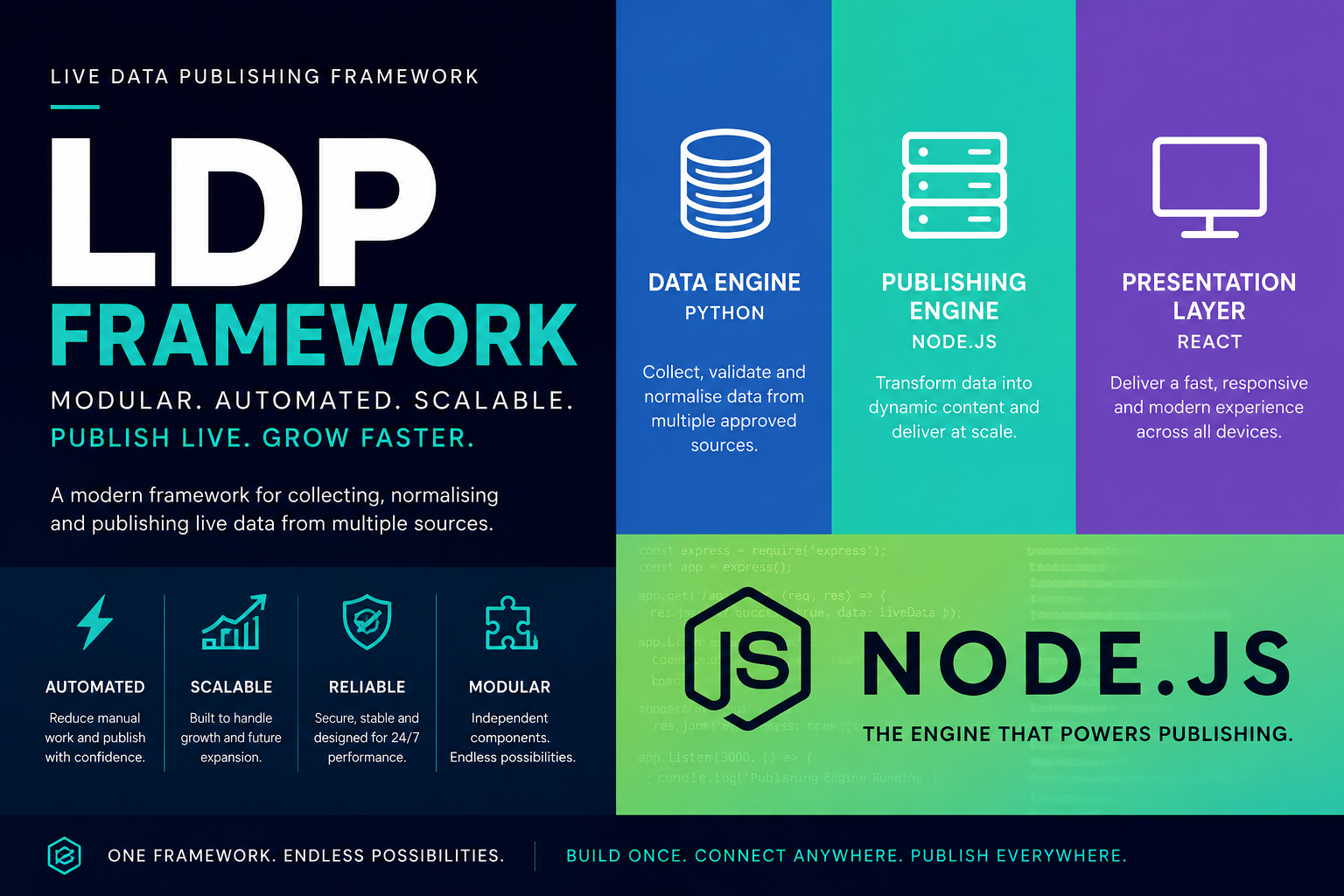
Within the Live Data Publishing Framework (LDP Framework), this responsibility belongs to the Publishing Engine.
Rather than collecting data itself, the Publishing Engine focuses entirely on transforming structured information into a modern publishing platform.
Separating Responsibilities
One of the guiding principles of the LDP Framework is that each component should perform a clearly defined task.
The Data Engine collects and prepares information.
The Publishing Engine decides how that information is organised, searched, categorised and delivered to visitors.
This separation makes the overall system easier to understand, maintain and expand.
Why Node.js?
Node.js has become one of the most widely adopted technologies for modern web applications.
Its event-driven architecture makes it particularly well suited to applications that need to respond quickly to many simultaneous requests.
Within the LDP Framework, Node.js provides the logic that sits between stored data and the visitor viewing the website.
It is not responsible for collecting external data. Instead, it acts as the intelligent layer that determines what information should be presented, how it should be filtered and how quickly it should be delivered.
The Publishing Engine’s Responsibilities
The Publishing Engine manages many of the tasks visitors never see directly.
These include:
- Building category pages dynamically.
- Processing search requests.
- Applying filters and sorting rules.
- Generating dashboards.
- Managing pagination.
- Delivering structured information to the frontend.
- Supporting future automation features.
Each responsibility remains independent of the data collection process, allowing both systems to evolve without affecting one another.
Dynamic Publishing
Traditional websites are often built around manually created pages.
The LDP Framework takes a different approach.
Pages become dynamic views generated from structured information already stored within the system.
Instead of manually updating hundreds of pages, the Publishing Engine assembles content automatically based on predefined rules and available data.
This approach improves consistency while reducing repetitive administrative work.
Performance Through Structure
Performance is not achieved by a single optimisation.
It is achieved by thoughtful architecture.
Because the Data Engine has already completed the heavy work of collecting and preparing information, the Publishing Engine can focus entirely on delivering that information efficiently.
This separation reduces unnecessary processing during page requests and creates opportunities for future caching, indexing and performance optimisation.
Preparing for Growth
Although the first implementation of the LDP Framework focuses on a specific publishing project, the Publishing Engine has been designed with future expansion in mind.
New connectors, additional content types and entirely different publishing models can be introduced without fundamentally changing the engine itself.
The objective is not simply to build a website.
The objective is to build a reusable publishing platform.
Looking Ahead
The Publishing Engine provides the intelligence that transforms structured data into meaningful information for visitors.
However, visitors never interact with the Publishing Engine directly.
Their experience is shaped by the final layer of the framework — the user interface itself.
In the next article, I will explore the Presentation Layer and explain how modern frontend technologies create responsive, intuitive interfaces while remaining independent of the underlying system architecture.